



Artificial intelligence is changing the way businesses approach everyday tasks. Instead of using AI only to answer questions or create individual pieces of content, businesses can now use AI systems to handle recurring workflows, organise information, support marketing activities, analyse data, and complete other routine work.
For many teams, the challenge is not finding another tool. It is creating a workflow that actually saves time without adding more complicated processes. This is where AI agents can become useful. An agent can be designed around a specific task, connected to the tools a business already uses, and scheduled to complete work repeatedly.
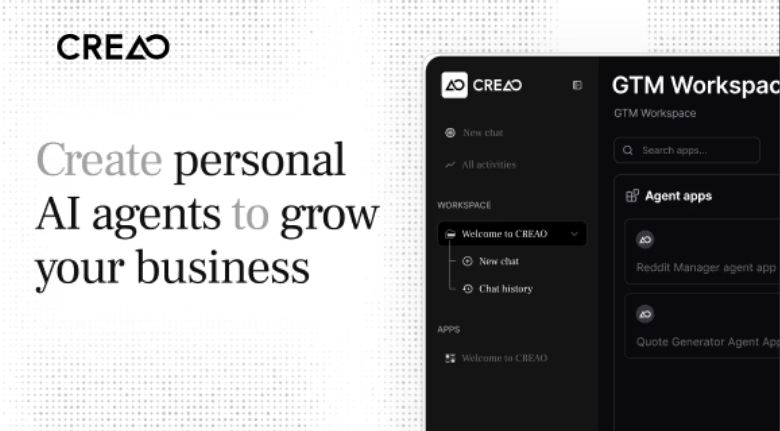
CREAO is an AI platform built around this approach. Users can describe a recurring task in natural language, and the platform can turn that work into an AI agent. These agents can run on schedules, connect with existing business tools, remember working preferences, and use approval steps when human review is required.
Start by Identifying Repetitive Tasks
Before creating an AI agent, it is useful to look at the tasks that take up time every week. Many businesses have recurring responsibilities that follow a similar process each time.
A marketing team might prepare social media ideas, update advertising materials, create content briefs, or review campaign information. An ecommerce business may need to monitor inventory, organise product information, or prepare regular reports. Freelancers may spend considerable time on research, administration, proposals, and client updates.
These tasks are good starting points because their structure can often be described clearly.
CREAO allows users to explain the work in plain language rather than requiring them to build a complicated automation from scratch. Its platform is designed to turn successful conversations and workflows into reusable agents that can continue performing the same type of work.
The most useful approach is to begin with one specific responsibility. Instead of asking an AI agent to manage an entire business, define a smaller task such as preparing a weekly report, creating an SEO brief, or reviewing incoming requests.
Once the workflow is working reliably, additional tasks can be introduced. This makes the transition to AI-powered work more manageable and easier to monitor.
Connect AI With the Tools You Already Use
AI becomes more practical when it can work with the information a business already relies on. Many companies use several platforms every day, including email, calendars, spreadsheets, communication tools, project management software, advertising platforms, and ecommerce systems.
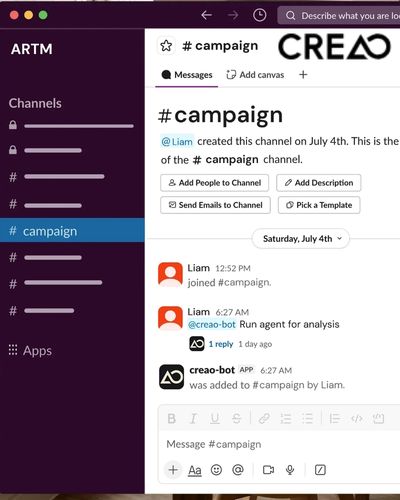
CREAO is designed to connect agents with existing tools through integrations. Its current platform highlights connections with services such as Gmail, Outlook, Slack, Microsoft Teams, Google Calendar, Notion, Asana, Google Sheets, Shopify, eBay, Google Ads, YouTube, Google Analytics, Google Search Console, and Semrush.
This type of connected workflow can reduce the need to repeatedly copy information between different applications.
For example, an agent could receive information from an email, check relevant details in a spreadsheet, prepare an output, and then wait for approval before sending a response. Another workflow could gather information from connected platforms and turn it into a recurring report.
The exact workflow will depend on the tools and permissions available, but the principle remains the same: the agent works within the environment where the business already operates.
This can be especially helpful for small teams. Instead of creating a completely separate system for every automation, businesses can build workflows around the tools they already know.
Schedule Agents for Recurring Work
One of the biggest differences between a normal chatbot interaction and an AI agent is the ability to perform recurring work. A chatbot may provide an answer when someone asks a question, while a scheduled agent can perform a task without requiring the same prompt every time.
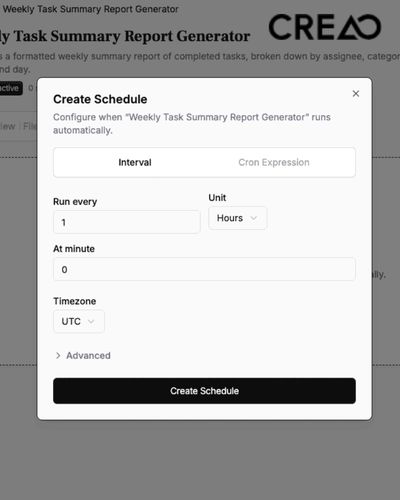
CREAO supports scheduled runs that can take place daily, weekly, through webhooks, or in response to certain events. Users can also choose how much autonomy an agent should have.
This can be useful for tasks that naturally repeat.
A marketing team could schedule an agent to prepare fresh advertising concepts every morning. An ecommerce operator could use a recurring workflow to review inventory information. A content team could schedule an SEO research process for upcoming topics.
Scheduling does not necessarily mean giving an agent unlimited control. Businesses can decide which actions should happen automatically and which should require human approval.
This distinction is important because not every task has the same level of risk. Creating a draft may be suitable for automation, while sending an important customer communication or making a significant change may deserve a final human review.
By defining the right level of automation for each workflow, teams can combine the speed of AI with appropriate oversight.
Use Memory to Create More Consistent Results
Repeating the same instructions every time can make AI workflows less convenient. A useful agent should understand the preferences and information that matter to the work it performs.
CREAO includes memory capabilities that can carry information across conversations and agents. The platform says preferences, decisions, files, and working styles can be captured and reused, allowing new agents to start with more context.
This can be valuable for businesses with established processes.
For example, a company may have a preferred writing style, reporting format, approval process, or set of customer communication guidelines. Instead of explaining those requirements repeatedly, an agent can use the stored context when performing future tasks.
Memory can also help create greater consistency between different workflows. If several agents support the same business, they can work from shared knowledge and established preferences where appropriate.
However, businesses should still review important outputs. Memory can make workflows more consistent, but human oversight remains useful when information changes or when a task requires a specific judgement.
The goal is not simply to make AI remember everything. The goal is to make recurring work easier by preserving the context that actually matters.
Create Content and Media From One Workflow
Modern business workflows often involve more than written text. Marketing teams may need images, videos, presentations, voiceovers, product visuals, and other creative assets.
CREAO brings several of these capabilities into the same agent environment. Its current platform describes support for video generation, image generation, voice and speech, browser-based actions, and other AI-powered tasks.
For a marketing workflow, this could mean moving from an idea to several types of creative output within one connected process.
For example, a business could create an agent designed to develop advertising concepts. The workflow might begin with campaign information, generate several creative ideas, prepare copy, create supporting visuals, and organise the results for review.
The advantage of this approach is that the creative process can be connected instead of being divided across multiple unrelated tools.
AI-generated content should still be reviewed before publication. Brand guidelines, factual accuracy, image suitability, tone, and audience expectations all require attention. Automation can speed up production, but final quality depends on how the workflow is designed and reviewed.
For businesses that regularly produce digital content, bringing several creative capabilities into one environment can make the overall process easier to organise.
Build a More Practical AI-First Workflow
The most effective use of AI does not necessarily come from automating everything at once. A more practical approach is to identify repetitive work, build one reliable workflow, review its results, and gradually expand from there.
CREAO describes this process as a cycle in which agents run tasks, remember how the business operates, and improve future work through repeated use. The platform also supports reusable agents that can be shared and managed within workspaces.
For a small business, this could start with one marketing workflow. For an ecommerce operator, it might begin with inventory or product-related tasks. A freelancer could create agents for research, reporting, or client administration.
The important part is choosing a workflow where automation can provide genuine value.
It is also worth deciding where human approval belongs. CREAO currently supports approval gates for actions that users may want to review before they are completed automatically.
This creates a balance between automation and control. Routine actions can move forward automatically, while more important decisions can pause until someone checks the result.
AI agents are becoming increasingly useful because they can move beyond one-time answers and become part of ongoing business processes. With the right setup, they can help teams handle repetitive responsibilities, connect information across tools, maintain working context, and produce different types of outputs.
CREAO brings these ideas together through AI agents, scheduled workflows, integrations, memory, creative tools, and configurable levels of autonomy.
For businesses exploring AI, the best starting point is often simple: identify one recurring task, define the desired result, connect the necessary tools, and create a workflow that can be reviewed and improved over time. As those individual workflows become reliable, AI can become a more integrated part of everyday business operations rather than simply another tool used occasionally.